
Belarusian Passports in Spain: Residency Renewal Guide

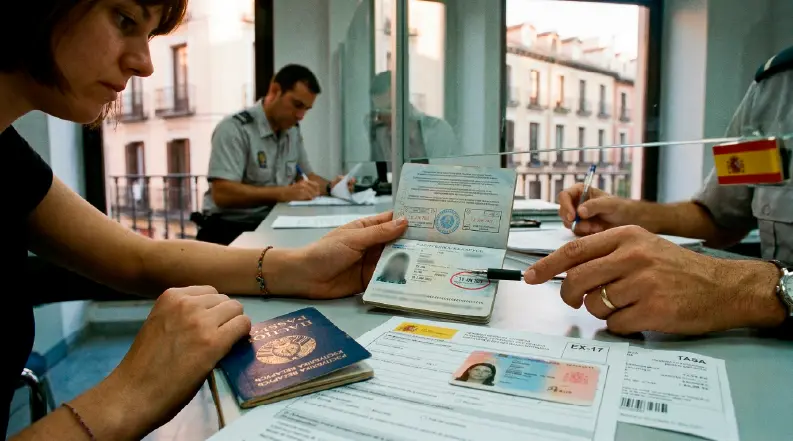
Since September 2023, citizens of the Republic of Belarus have faced an unprecedented legal collision: the entry into force of Decree No. 278 stripped diplomatic missions of their authority to issue and exchange identification documents abroad. For thousands of residents, this means that a Belarusian passport in Spain can no longer be renewed without a personal visit to their country of citizenship. However, for many, returning entails risks of political persecution, criminal prosecution, or other insurmountable circumstances.
The expiration of a travel document directly blocks your ability to legally reside in the country: without a valid ID, it is impossible to renew a resident card, open a bank account, sign a lease agreement, or enter into an employment contract. There is a direct risk of losing your legal status.
The legal team at VissumLex states: Spanish immigration law contains clear mechanisms to protect foreigners who find themselves in a situation of documentary vulnerability (indocumentación). The law dictates that the lack of a national passport is not grounds for losing a residence permit, provided the foreigner has taken exhaustive measures to obtain one and can prove it. In this article, we will detail the legal step-by-step algorithm for 2026, based on the current regulatory framework and our daily judicial and administrative practice.
Alternative to Belarusian Passports in Spain: What is a Cédula de inscripción?
A Cédula de inscripción (Certificate of Registration) is an official identification document issued by the Spanish Ministry of the Interior (Ministerio del Interior) to foreign citizens who cannot be documented by the authorities of their home country.
The legal basis for this instrument is established in Article 34 of Organic Law 4/2000 (Ley Orgánica 4/2000, de 11 de enero) and detailed in Article 211 of the Immigration Law Regulations (Real Decreto 557/2011). The law explicitly states that Spain is obliged to provide an alternative document to individuals whose states deny them consular services.
Authority: Joint Instruction of the Police and Immigration Authorities
The key document regulating the legalization process for Belarusians in the current reality is the Instrucción conjunta (Joint Instruction) issued by the General Director of the Police and the General Director of Migration Management. This internal regulatory act was developed specifically to unify the practices of police stations across Spain and eliminate arbitrary refusals.
Direct translation of the key provision of the Instrucción conjunta:
"In cases where a foreign citizen provides documentary evidence of the impossibility of obtaining a passport through the diplomatic or consular missions of their country for reasons beyond their control, the competent authorities are obliged to initiate the procedure for issuing a Cédula de inscripción. The refusal to issue a national passport for political reasons or due to a change in the national legislation of the country of origin is recognized as sufficient grounds for applying Article 34 of LO 4/2000."
This instruction is our primary legal shield. It proves that renewing residency without a passport is not a favor from an inspector, but your legal right. The document clearly delineates competencies: if a person requests international protection, the case is handled by the Oficina de Asilo y Refugio (Asylum and Refugee Office). If the person already has a residence permit and simply needs an identification document, the process goes through the General Directorate of the Police (Comisaría de Policía Nacional).
Step-by-Step Guide: How to Legalize Your Status Without a Passport
Many clients ask: how to get a cédula de inscripción without the risk of refusal? The procedure requires strict sequencing and flawless preparation of the evidence base. The Spanish immigration police do not take your word for it—every fact must be documented.
Step 1: Documenting the Impossibility of Obtaining a Passport
This is the most critical stage. You cannot simply walk into a police station and state that the Belarusian consulate is not issuing passports. You must prove that you have personally exhausted all available methods.
Our legal practice has developed the following ironclad algorithm:
Acta Notarial de Requerimiento (Notarial Act of Request): We engage a Spanish notary who officially sends a request to the Embassy of the Republic of Belarus in Madrid, demanding the issuance of a new passport to our client.
Burofax with acknowledgment of receipt: An official postal dispatch to the consular section requesting the renewal of the document.
Recording the refusal or silence: According to Spanish administrative law (Ley 39/2015), the lack of a response from a government body within the established timeframe (silencio administrativo) is equated to the impossibility of receiving the service. The notary records this fact in an official act (Acta de Notoriedad).
Only with this notarial act in hand can we prove to the police that your Belarusian passport in Spain cannot be renewed for reasons beyond your control.
Step 2: Submitting the Cédula Application to the Police
Having gathered the evidence base, we initiate administrative proceedings at the National Police station corresponding to your registered address.
Mandatory document package:
Completed EX-16 form (Solicitud de Cédula de Inscripción o Título de viaje).
Paid state fee (Tasa 012).
Original and full copy of the expired passport.
Valid resident card (TIE).
Recent certificate of registration (Certificado de empadronamiento).
Notarial act confirming the impossibility of obtaining a passport (the result of Step 1).
Documents confirming humanitarian reasons or other compelling grounds preventing return to the country of origin (if applicable, although for citizens of the Republic of Belarus, a reference to Decree No. 278 is currently sufficient).
The police conduct a background check (informe policial) to ensure you have no criminal record in Spain and pose no threat to national security. The legal processing time is up to 3 months; however, in practice in Barcelona and Madrid, the process can take 4 to 6 months.
Step 3: Obtaining a Título de viaje (if you need to travel)
It is important to understand the legal difference: a Cédula de inscripción is an internal document that replaces a passport within Spanish territory. It does not grant the right to cross state borders.
If you need to travel, the law allows you to request a Título de viaje (Foreigner's Travel Document). This is a blue booklet, visually similar to a passport, issued under Article 212 of the Regulations (RD 557/2011). The application for a Título de viaje is submitted using the same EX-16 form, often simultaneously with the Cédula request. With this document, you can legally travel outside Spain and return without violating the visa regime.
Renewing Residency (Renovación) with a Cédula de inscripción
Once you have the Cédula in hand, renewing residency without a passport transitions into a standard procedure, but with important procedural nuances.
When submitting an application to renew your residency (whether it is a non-lucrative visa, investor visa, or work residency) through the Mercurio platform, we use the standard forms (EX-01, EX-03, EX-07, or EX-10). However, in the "Pasaporte" field, the details of your Cédula de inscripción are entered.
Key legal nuances:
Synchronization of terms: The validity period of your new TIE card will be directly tied to the validity period of the Cédula de inscripción (usually issued for 1 year with the right to annual renewal).
Maintaining continuous residency: Using an alternative document does not interrupt your period of legal residence in Spain. You continue to accumulate years toward obtaining long-term residency (Larga Duración) or citizenship.
Interacting with banks: Spanish banks (CaixaBank, BBVA, Santander) are obliged to accept the Cédula de inscripción as part of KYC (Know Your Customer) procedures to unblock and maintain accounts. Our team provides clients with special legal opinions (Informes Jurídicos) for bank compliance departments to prevent the freezing of funds.
VissumLex Practice: Real Cases from 2025-2026
Theory is dead without practice. The VissumLex team solves such tasks daily. Let's look at a typical case from our practice in early 2026.
Situation:
A family from Minsk (3 people) resides in Barcelona on a non-lucrative residence permit (Residencia no lucrativa). The head of the family's Belarusian passport in Spain had expired, and the resident cards were due to expire in 2 months. Independent attempts to book an appointment at the consulate led nowhere. Returning to Belarus was impossible due to the head of the family's participation in the 2020 protests.
VissumLex Solution:
We immediately initiated the procedure to document the refusal via a notary. In parallel, we prepared a comprehensive memorandum for the police, citing the Instrucción conjunta and the jurisprudence of the Spanish Supreme Court.
Result:
Within 45 days, we secured the issuance of a Cédula de inscripción for all family members. Based on this document, we successfully submitted the paperwork for renewing residency without a passport. The Immigration Office (Extranjería) approved the residency renewal for the next 2 years. The clients maintained their legal status, access to bank accounts, and the right to live freely in Spain. We achieved a 100% success rate in this case by strictly following the letter of the law.
Why is it Dangerous to Do This Yourself?
Many foreigners, trying to save money, search forums for "how to get a cédula de inscripción" and make fatal mistakes. Spanish immigration law does not forgive amateurism.
Risk of refusal due to weak evidence: If you bring a mere printout of an email to the embassy to the police, you will be rejected. The police require legally significant evidence (Acta Notarial).
Loss of legal status: A refusal to issue a Cédula means you will not be able to renew your residency. As soon as your card expires, you will transition into an illegal status (situación irregular).
Threat of deportation: Being in Spanish territory without valid identification documents and without a residence permit is a serious offense (infracción grave) under Article 53.1.a of the Immigration Law. This is punishable by a fine or deportation with a ban on entering the Schengen area for up to 5 years.
Do not risk your future and the future of your family. Entrust this complex administrative process to professionals who bear legal responsibility for the result.
FAQ (Frequently Asked Questions)
Can I travel around Europe with only a Cédula de inscripción?
No. The Cédula itself is strictly an internal identification document within Spanish territory. To cross state borders, you must additionally apply for a Título de viaje (Foreigner's Travel Document) at the police station.
How long before my passport expires should I start the procedure?
We recommend starting the process 6 months before your passport expires. The procedure for notarial documentation of the consulate's refusal and the subsequent review of the application by the police takes time, and it is crucial to obtain the document before applying for your residency renewal.
Will a Cédula de inscripción replace my passport at a Spanish bank?
Yes. According to Spanish anti-money laundering legislation (Ley 10/2010), a Cédula de inscripción is an official document certifying the identity of a foreigner. Banks are obliged to accept it to update your data and unblock your accounts.
Can I request a Cédula if I am in the process of obtaining political asylum?
No. If your case is being reviewed by the Oficina de Asilo y Refugio, you are under the protection of the Geneva Convention and receive special asylum seeker documents (Tarjetas rojas). The Cédula de inscripción is intended for individuals with standard types of residency (students, investors, workers).
What should I do if the police refuse to accept my Cédula application?
Demand a written, reasoned refusal and file an administrative appeal (Recurso de alzada). Our practice shows that the presence of a lawyer during the submission of documents and a reference to the Instrucción conjunta eliminate unlawful refusals on the spot.
Is your residency expiring and your passport invalid? Don't wait until the situation becomes critical.
The VissumLex legal boutique provides full, turnkey support for the legalization process in Barcelona and online throughout Spain. We speak RU/ES/EN and handle all communication with government authorities on your behalf. Entrust the process to lawyers—book your initial consultation right now, and we will develop a personalized strategy to protect your legal status.


